
- chantaljudicaelelisatoselli
-
 Kamis, 31 Maret 2016
 -
 0 Comments


Ebook Download The Toyota Product Development System: Integrating People, Process And Technology
Ultimate book collections can be gotten if you always visit this page. Locate the million of publications right here. All categories from many resources, publishers, and also writers around the globe exist. We not only supply guide collections from within this country. Numerous gathered publications are from the outsiders. Nonetheless, the aims are very same. They are given as a joined library by online to offer more precious resources to get the book.
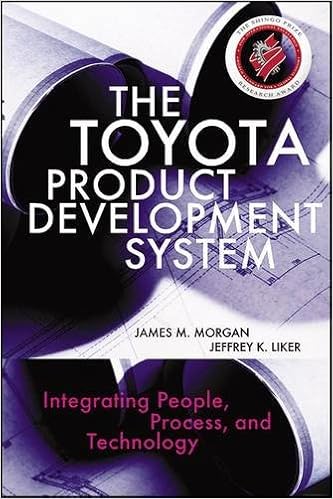
The Toyota Product Development System: Integrating People, Process And Technology

Ebook Download The Toyota Product Development System: Integrating People, Process And Technology
When a new choice comes to be a new manufacturer of much better living, why should regret of it? Something old have to be transformed as well as restored with something new, if the brand-new thing is much better. As the additional task that we will recommend, if you have no concept to appreciate your leisure time, reading could help you to pass the time wisely. Yeah, killing time totally can be done by everyone. However, be wisely in investing the time is very uncommon. So, do you wish to be among the wise people?
If you truly wish to be smarter, analysis can be among the lots methods to evoke and recognize. Lots of people who like analysis will certainly have more understanding and experiences. Checking out can be a means to gain information from business economics, national politics, scientific research, fiction, literary works, religion, and numerous others. As one of the part of publication classifications, The Toyota Product Development System: Integrating People, Process And Technology constantly becomes the most wanted book. Many people are absolutely looking for this book. It indicates that numerous like to read this kind of publication.
You know, as the advantage of reading this The Toyota Product Development System: Integrating People, Process And Technology, you may not only get new knowledge. You will certainly really feel so enjoyable and pleasurable when reviewing it. It verifies by the presence of this publication, you can make use of the time flawlessly. Investing the moment when going to house will certainly be useful sufficient when you know truly exactly what should do. Reviewing is just one of the best ways to do to accompany your leisure. Naturally, it will be more precious than just talking to the various other close friends.
Merely attach your device computer system or gadget to the net attaching. Obtain the modern innovation making your downloading and install The Toyota Product Development System: Integrating People, Process And Technology completed. Even you don't intend to review, you can directly shut the book soft data as well as open The Toyota Product Development System: Integrating People, Process And Technology it later. You can also easily obtain the book anywhere, considering that The Toyota Product Development System: Integrating People, Process And Technology it remains in your device. Or when being in the workplace, this The Toyota Product Development System: Integrating People, Process And Technology is also advised to review in your computer gadget.
From the Publisher
2007 SHINGO PRIZE WINNER!
Read more
About the Author
Dr. James Morgan has more than 24 year experience in automotive product development and operations management including almost 20 years at TDM, a tier one automotive supplier of engineering services, tools and vehicle subsystems where he was Vice President. He holds MS and Ph.D. degrees in Engineering from the University of Michigan where he completed a three year, Shingo Award winning comparative study of Toyota and a North American competitor's product development systems. Dr. Morgan's research has lead to a coherent systems model of lean product development which he has utilized in analyzing and improving the development systems of several Fortune Fifty companies in both the U.S. and Europe. Dr. Morgan has published a number of articles and developed and taught classes and seminars at The University of Michigan, the Lean Enterprise Institute, the Lean Enterprise Academy, and the Society of Automotive Engineers. Dr. Morgan is currently an Engineering Director at Ford Motor Company. Dr. Jeffrey K. Liker is Professor of Industrial and Operations Engineering at the University of Michigan. Dr. Liker has authored or co-authored over 70 articles and book chapters and seven books. He is author of the international best-seller, The Toyota Way: 14 Management Principles from the WorldÂ’s Greatest Manufacturer, McGraw Hill, 2004. The companion practical implementation guide,(with David Meier) The Toyota Way Fieldbook, Mcgraw Hill, 2005 (2005 Shingo Prize winner), details how companies can learn from the Toyota Way principles. He is also the Editor of Becoming Lean: Experiences of U.S. Manufacturers (Productivity Press, 1997), winner of the 1998 Shingo prize. Other books by Dr. Liker include Engineered in Japan, (Oxford University Press, 1995); Concurrent Engineering Effectiveness: Integrating product development across organizations (Hanser-Gardner, 1997), and Remade in America: Transplanting and Transforming Japanese Manufacturing Methods (Oxford University Press, 1999).
Read more
Product details
Hardcover: 400 pages
Publisher: Productivity Press; 1 edition (March 25, 2006)
Language: English
ISBN-10: 9781563272820
ISBN-13: 978-1563272820
ASIN: 1563272822
Product Dimensions:
6 x 1 x 9 inches
Shipping Weight: 1.5 pounds (View shipping rates and policies)
Average Customer Review:
3.9 out of 5 stars
31 customer reviews
Amazon Best Sellers Rank:
#342,167 in Books (See Top 100 in Books)
Toyota is agreat example for a consumer technology company. Reading that you can understand better the DNA of Toyota success and growth, before and after 2006 when it was published.
Writers and readers are in a relationship. Each has responsibilities. The writer is responsible for the structural quality of his writing such as spelling, grammar, punctuation, and vocabulary. (The language should be invisible in high quality writing so that the reader can focus on the content i.e. the writer’s message.) The reader is responsible for being fluent in the language to understand high quality writing.This book should never have been published just for its atrocious quality of writing. It is filled with spelling mistakes, terrible grammar, and horrid punctuation. These issues, in addition to needless Japanese jargon, car jargon, and undefined acronyms, interrupted reading so often that I had to put the book away every few pages. This is especially frustrating as the book is fundamentally about building quality in into a product! There is no indication that this was done in the production of this book.I am deeply interested in the product development process. Experience with several companies has shown me that their respective product development process, if it exists as such, is poorly designed, poorly defined, and not effective in operation. So I have been studying—I’ve read Stuart Pugh’s “Total Designâ€, Don Clausing’s “Total Quality Developmentâ€, and Ulrich/Eppinger’s “Product Design and Developmentâ€, among other books and papers. Given that Toyota excels at bringing great products to market quickly, I really wanted to learn and understand its approach. So it was with this intent, and Jeffrey Liker’s reputation, that I picked up “The Toyota Product Development Systemâ€.The book does not deliver what its title promises. The authors do not provide a model of the product development process, instead discussing the sociotechnical system (STS) at Toyota, the V-Comm communication system, and PDVSM—product development value stream mapping to improve the product development process. This is already superbly detailed in Jeffrey Liker’s “The Toyota Wayâ€. We get it—the product development process at Toyota is grounded in its world leading STS, but what is the process specifically? The author’s don’t detail the product development process as I’ve come to expect from reading Pugh, Clausing, Ulrich/Eppinger. Perhaps that is a failure on my part.How are design inputs collected and/or developed? How are those inputs converted into engineering terminology? If Toyota doesn’t use the House of Quality, what does it use? How are engineering requirements converted into sets of concepts? There is no usable explanation of set-based concurrent engineering. For crying out loud, Jeffrey Liker wrote several papers on this! What is the method for vetting various concepts? How does detailed engineering happen i.e. converting requirements into drawings? How are those concepts verified and/or validated? What type of testing is performed or skipped? When is it done? None of the things that would help a design and development engineer to understand the design and development process at Toyota is covered in any useful way.When these questions are touched upon, they are done so piecemeal and superficially; disconnected from one another. The authors make the reader work very hard to extract nuggets from their writing. The discussion often happens in the context of an example, but the examples require you to know car terminology! So if you don’t have experience in the automobile industry, good luck trying to figure out what the authors are trying to communicate. (Thank you Google & Wikipedia for helping me see what is meant.) The matter is made worse by the fact that an example doesn’t carry through between discussion of topics.One final note, there is a ridiculous amount of adoration of Toyota’s results that borders on worship. I didn’t care for that, especially when what I was looking for—the description of process—was missing. I didn’t buy the book for the authors to tell me how good Toyota is and how bad everybody else is. I already know this. It is unfortunate that several masters in lean wrote rave reviews for the book. I wonder if they bothered to actually read it. I am now less inclined to be guided by their reviews and recommendations. My suggestion to you is you skip this book. It isn’t worth anyone’s time.
Lean originated on the production floor over sixty years ago in Japan. But Toyota product development has been sadly overlooked by corporate America. Where is the connection between Toyota stellar production practices and Toyota product development? You can't argue with the tried and true principles to systematically eliminating waste--that is the bedrock of the lean philosophy. Lean thinking is making inroads to a number of different environments and industries beyond discrete assembly like car making. Does waste occur in non-manufacturing? Oh yes, and it has largely been an untapped, dormant opportunity for applying lean. Improvement initiatives are being re-focused on office settings and now product development. There aren't many product development(PD)lean books out there but, Liker's book is excellent--it is so thorough, well researched, logical and well written! A lean novice may have difficulty because it is not "lean 101" and PD is not quite the same as lean manufacturing. But, if I forced to pick a single book on lean product development--this would be my #1 pick. It is such a good start point for lean PD. The lean benefits are self evident: cut development time in half and never miss milestones? That's has been the Toyota norm. Liker's book will walk you thru the 14 principles on how to get there the subsystem levels (Processes-People-Tools/Technology). If your PD efforts are adrift, it's reassessment time. Start here. You won't be sorry.
It is always useful to read how a world-class organization like Toyota defines and improves its work processes... This book shows how Toyota executes its product development strategies through an emphasis on technical excellence, process discipline and continuous improvement ... In other words, the Toyota system product development system is focused on technical excellence for the long term using teamwork and employee empowerment... This is a great book written by people who actually worked at Toyota.
Great book explaining some of the aspects of how Toyota does so well.
Great product. ......
The Toyota Product Development System: Integrating People, Process And Technology PDF
The Toyota Product Development System: Integrating People, Process And Technology EPub
The Toyota Product Development System: Integrating People, Process And Technology Doc
The Toyota Product Development System: Integrating People, Process And Technology iBooks
The Toyota Product Development System: Integrating People, Process And Technology rtf
The Toyota Product Development System: Integrating People, Process And Technology Mobipocket
The Toyota Product Development System: Integrating People, Process And Technology Kindle


0 komentar: